EMT Practice Test

1. Question Content...
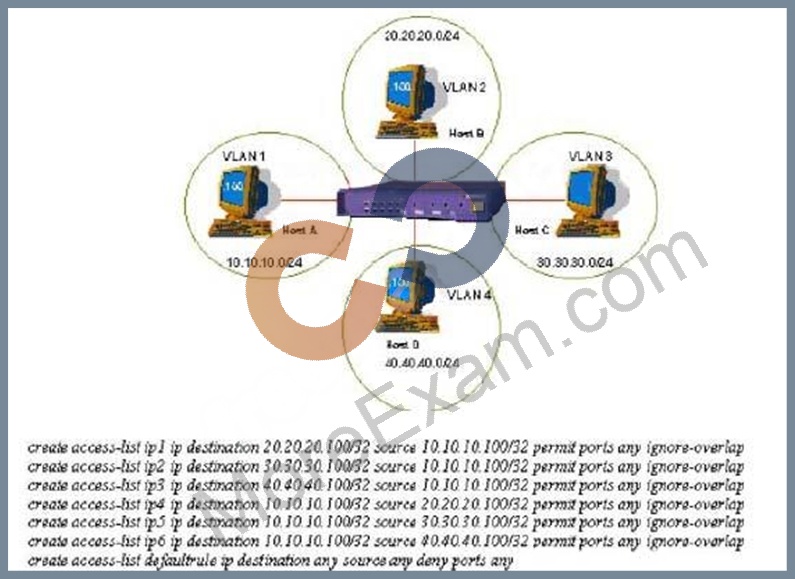

Question List

Question1:
According to accompanying diagram and ACL configuration it is possible to telnet from host A to any of the
switch IP addresses.

Question2: In general IS-IS allows routing of both IP and OSI packets.
What type of Implementation does ExtremeWare support?

Question3: Which CLI command would you use to configure vlan tracking towards vlan engineering for an ESRP
protected VLAN manufacturing?

Question4: When you create an ACL entry on Summit 48i switch it works in the following way

Question5: Within VRRP the election process of becoming the master switch takes place with the following
precedence
Step 1 The switch with the virtual router IP address becomes the master switch
Step 2 The switch with the highest VRRP priority becomes the master switch
Step 3 The switch with the highest IP address becomes the master switch

Question6: An IP-only IS-IS router (or "IP-only" router) is defined to be

Question7: The Address Resolution Protocol enables a device to learn a destinations MAC address by using the
destinations known IP addresses in the ARP request.

Question8: The following CLI command is valid to advertise SLB virtual servers in OSPF ith a cost of 10.
Enable ospf export vip cost 10

Question9: The Skew time in VRRP is used to ensure that two back-up routers do not switch to master state at the
same time an case of a fall-over situation.

Question10: The Summit 7i switch supports how many queues per interface?

Question11: A QoS building block that defines a class of service by specifying traffic behavior attributes like bandwidth
is called

Question12: What is the CLI command you would use to configure a VLAN to be protected by ESRP?

Question13: Dealing with an Access Control List on Extreme switches it's required to include a precedence number
when configuring the default rule.

Question14: When SSH2 is configured and enabled on a Summit 7i switch, telnet is automatically disabled.

Question15: The pre-empt option in VRRP is enabled by default on Extreme Networks switches.
Pre-empt ensures that

Question16: What is true of a Rendezvous Point in PIM-DM?

Question17: A QoS profile determines into which hardware queue a frame is enqueued.

Question18: The default OSPF router dead interval for Extreme Networks switches is

Question19: Which of the following items is included in a DVMRP routing table.

Question20: When configuring a Summit 5i for OSPF routing, it is recommended to manually configure the OSPF
router-id rather than setting the router-id set to automatic.

Question21: All Extreme switch products support the standard 802.1p priority bits that are part of a tagged Ethernet
frame.

Question22: Like OSPF stub areas, NSSA areas cannot be used as transit areas for virtual links.

Question23: Is it possible to configure a single physical port into different STPD's?

Question24: In a stable OSPF network, all OSPF routers in the same area must have the same LSDB contents.

Question25: Manual replication of saved images and configurations from the master MSM64i to the slave MSM64i on
the BlackDiamond 6804 is done with the synchronize command.
However execution of this command does not replicate the run-time configuration.
You must use the save configuration command to store the run-time configuration first.

Question26: What is the function of a Bootstrap Router?

Question27: The type of OSPF LSAs that are sent out within an automous system by an ASBR to advertise extreme
routes are

Question28: In normal operation the master node in the EAPS ring blocks the secondary port for all non-control traffic
belonging to the EAPS domain.

Question29: An OSPF router connected to a RIP network & performing route redistribution is considered

Question30: In a Summit 5i switch, a QoS policy is applied on a basis.

Question31: The following ExtremeWare components are required on Extreme Networks switches with the 'I" series
chipset to build an SLB system. (Choose all three that apply)

Question32: SSH2 on Extreme Networks 'i' series chipset switches enables encrypted telnet sessions towards the
witch. SSH2 Client and Server both have a private key and exchange a public key before the connection is
set-up.

Question33: The IS-IS Routing Protocol has been developed in ISO to provide routing for pure OSI environments.

Question34: By default all VLANs are assigned to QoS profile QP

Question35: There is one ACL type supported by Extreme Networks switches that can only be dealt by the CPU. Which
type is it?

Question36: OSPF requires that all areas attach directly to the backbone area, and that all attachments are made with
a direct physical connection.

Question37: In PIM sparse mode the Bootstrap Router election is based on the highest IP address.

Question38: Radius on Extreme Networks 'i" Chipset switches allows validation for the following switch access
methods?

Question39: IP Version 6 has amongst other differences with IP Version 4 also different address length. What is the
size of an IPv6 address?

Question40: What does IS-IS stand for?

Question41: What is the maximum number of ACL rules supported on an Extreme Networks Summit7i switch without
the default rule?

Question42: Which of the following CLI commands could you use to determine which ports are enabled for ESRP host
attach?

Question43: Select the statements that are true for IP multicast?

Question44: When a PIM-SM router wants to receive a Multicast stream, it

Question45: When limit-learning is configured on a port and the limit is reached the following traffic still flows to the port.

Question46: In Extreme Ware what is the normal ACL behavior for incoming traffic when there is no default rule
configured?

Question47: Extreme Networks "I" Chipset switches allows you to run simultaneously the Radius and Tacacs+features.

Question48: What is the RP-set?

Question49: How does an IGMP router learns about the existence of hosts in multicast groups

Question50: What mechanisms does a master node use to detect a failure in the EAPS ring architecture?
Select the two that apply.

Question51: Although you can specify sequence numbers for different ACL entries, the Summit 1i switch checks
incoming traffic on a match with the ACL entries in the order of their time in configuration

Question52: Select the incorrect statement for PIM.

Question53: What are the differences between a Summit 48i and a Summit 48si? Choose all that apply

Question54: Is it possible to create multicast STPD on a switch?

Question55: Select the correct statements related to IP Multicast?

Question56: in IS-IS level 1/2 routers act as border routers to their respective areas, providing connectivity to other
areas.

Question57: VRRP is

Question58: On a RADIUS server you can distinguish between switch access and Netlogin authentication. Extreme
provides a vendor specific attribute ExtremeExtreme-Netlogin-only =disabled/enabled.
User authentication for both Netlogin and switch access is allowed when the value is disabled.
When the value enabled user authentication is restricted to Netlogin only.

Question59: In SLB, Port Translation Mode is similar to Translation Mode, except that in Port Translation Mode the
physical Port where the node connects to must be configured as a Fast Ethernet Half Duplex port.

Question60: Unlike VRRP, the eExtreme Standby Router Protocol provides redundancy at both the data link and
network layers of the ISO-OSI seven-layer model.

Question61: Which CLI command enables all multicast traffic to multicast routers only?

Question62: What is the meaning of the IEEE 802.3 SNAP field in an Ethernet frame?

Question63: IS-IS routing uses two levels of hierarchical routing level 1 and level 2.
A level 1 router has full knowledge of the topology in the whole routing domain in a network with multiple
areas.

Question64: The DHCP, HTTP and RADIUS functions that are required for Netlogin are supported on the Extreme
Networks switch, where RADIUS function is restricted to client mode.

Question65: What does the abbreviation DVMRP stands for?

Question66: A stream of IP Multicast packets is addressed to

Question67: IGMP v1 supports the leave group message.

Question68: The Alpine 3802 switch contains a 3-slot chasis that can be populated with up to three I/O modules.

Question69: On an Extreme Networks switch, how many bits comprise an OSPF area ID?

Question70: Dealing with access control lists on Extreme Networks switches it is not required to manually configure the
default rule.

Question71: In SLB a virtual server cannot belong to the same VLAN as the nodes in the referenced pool.

Question72: Which statement is true about integrated IS-IS.

Question73: What configuration is send when you upload a configuration from a Summit 1i switch to a TFTP server?

Question74: An LSP is a link state packet used by which routing protocol?

Question75: What are the advantage/s of using integrated IS-IS as a routing protocol?

Question76: _________ is an ESRP option that allow(s) multiple VLANs to be controlled by a single instance.

Question77: The CLI Command configure ospf delete vlan all? Will do the following on an Extreme switch.

Question78: When the CLI command show vlan corporate, is issued, the Protocol field has a value of NONE. Why is
this so?

Question79: By default, the OSPF routerID for an Extreme switch is selected automatically, and uses the lowest IP
address of the router interefaces.

Question80: In OSPF, the router type that is required to connect an area with another area is the

Question81: A QoS policy is the result when you assign a traffic grouping to a QoS profile when configuring QoS on a
Summit1i switch.

Question82: OSPF Hello packets are recognized by all routers in the same area.

Question83: DVMRP is similar to OSPF in that it is Link State based.

Question84: Which of the following is not advertised in an OSPF Link State Advertisment?

Question85: When you configure EAPS the following must apply.

Question86: Which of the following is the default ESRP priority setting for an Extreme switch?

Question87: What is an IGP protocol other than OSPF that uses the Dijkstrat's SPF routing algorithm?

Question88: The integrated IS-IS protocol allows for mixing of IP-only,OSI-only, and dual (IP and OSI) routers.